Compliance

Frameworks, risks and registers — tied to the law.

Run your frameworks from one place. Each one is broken down into what it asks of you — controls, policies, registers, incidents — and every requirement cites the article it comes from.

DORANIS2AI ActGDPR— plus the other frameworks you answer to, and your own standards.
Tied to the lawevery requirement cites the article it comes from
Confirmedthe rules propose a classification; a person confirms it
Recorded oncea risk, a control or a supplier counts wherever it applies
Dateddeadlines worked out from the rules that apply

Frameworks

Each framework, broken down into what it asks of you.

DORA

Digital operational resilience

  • ICT risk controls, with their status and applicability.
  • Major ICT incidents classified, with their reporting deadlines.
  • Critical or important functions assessed against the legal criteria.
  • The register of information, exported in the EBA template and checked before you file.
More on DORA
NIS2

Cybersecurity

  • Significant incidents assessed, with the notification timeline.
  • The policies the directive expects in writing.
  • Suppliers flagged as part of your supply chain.
  • Under DORA as well? Your incidents are routed to DORA first.
More on NIS2
AI Act

The AI systems you use

  • An inventory of your AI systems, with their provider and owner.
  • A classification proposed — prohibited, high-risk or not — that you confirm.
  • The deployer duties that follow, system by system.
  • A check for when using a system makes you its provider.
More on the AI Act
GDPR

Personal data

  • Records of processing, with the fields the regulation lists.
  • DPIA screening against the cases where one is required.
  • Data-subject requests and their deadlines — kept as a reference, never the person’s details.
  • Personal-data breaches assessed for notification.
More on GDPR

Beyond these four

The other frameworks you answer to — and your own.

These four are where most firms start. RegNext manages other frameworks the same way, and a standard of your own runs beside them, on the same controls.

Ready to start from

A framework comes with controls and readiness questions. Each control is tied to the requirements it answers, with their article.

Updates you can read

A new version shows exactly what changed, and never overwrites your own edits.

Your own standard

Import a standard you hold or an internal rulebook. Its requirements map to the same controls, so one control can serve both.

Risks & controls

Know your risks, and whether your controls hold.

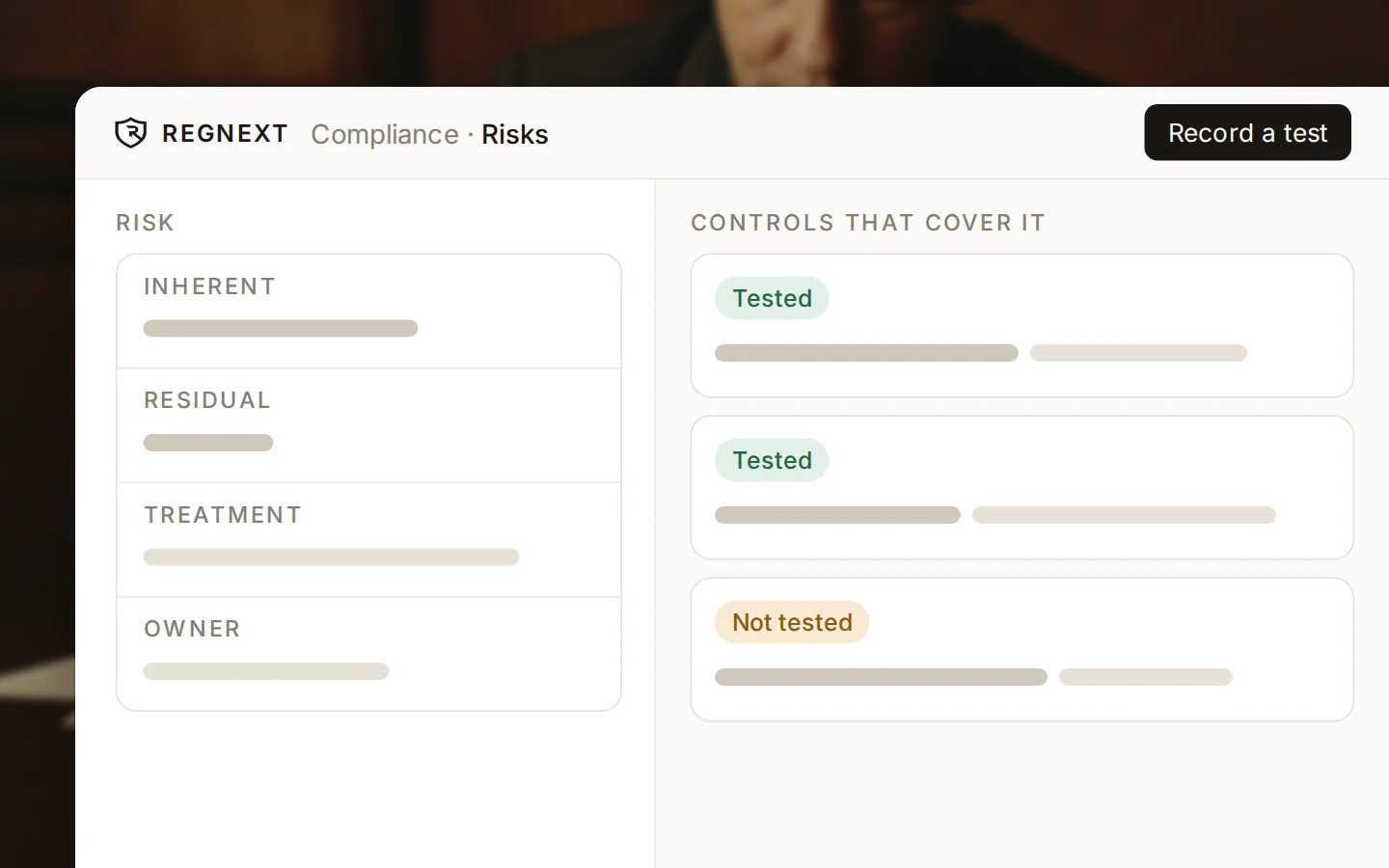
A risk register with inherent and residual ratings on a heat map, treatment decisions and owners — linked to the controls that cover each risk. Controls carry their status, their applicability per framework and their test results.

A risk from the lawHighlight a passage of a regulation and turn it into a risk.
Control testingRecord each test and see where your controls stand.
Suggested mappingsControls matched to the requirements they meet.
Regulator activityRecent enforcement, shown for each risk category.
A risk with its inherent and residual ratings, its treatment and its owner, beside the controls that cover it, marked tested or not tested, and a Record a test button

Policies

Policies that keep up with the law.

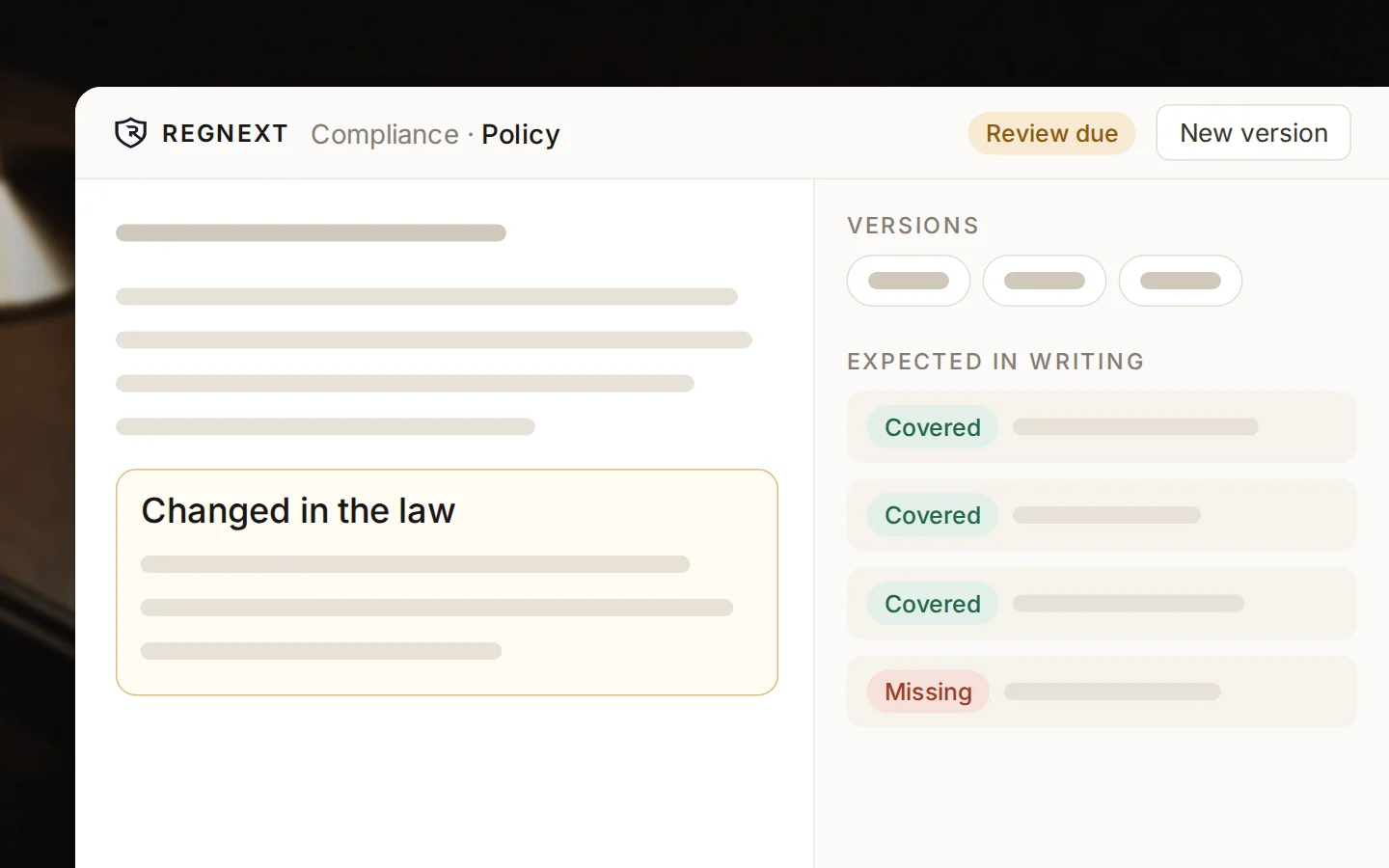
Every policy is versioned, with its owner and its review date. See what each framework expects in writing, what changed in the linked law since your last review, and where your policy falls short. Start from templates, each tied to the article that requires the policy and filled in with your firm’s profile.

Versions keptGoing back creates a new version; history is never rewritten.
Review datesOverdue and soon-due policies flagged.
Expected in writingWhat the law asks you to have in writing, quoted.
Gap analysisYour policy read against the obligations it should meet.
A policy marked Review due, with a box titled Changed in the law, beside its versions and the list of what is expected in writing, marked covered or missing

Incidents

One incident, assessed under every framework that applies.

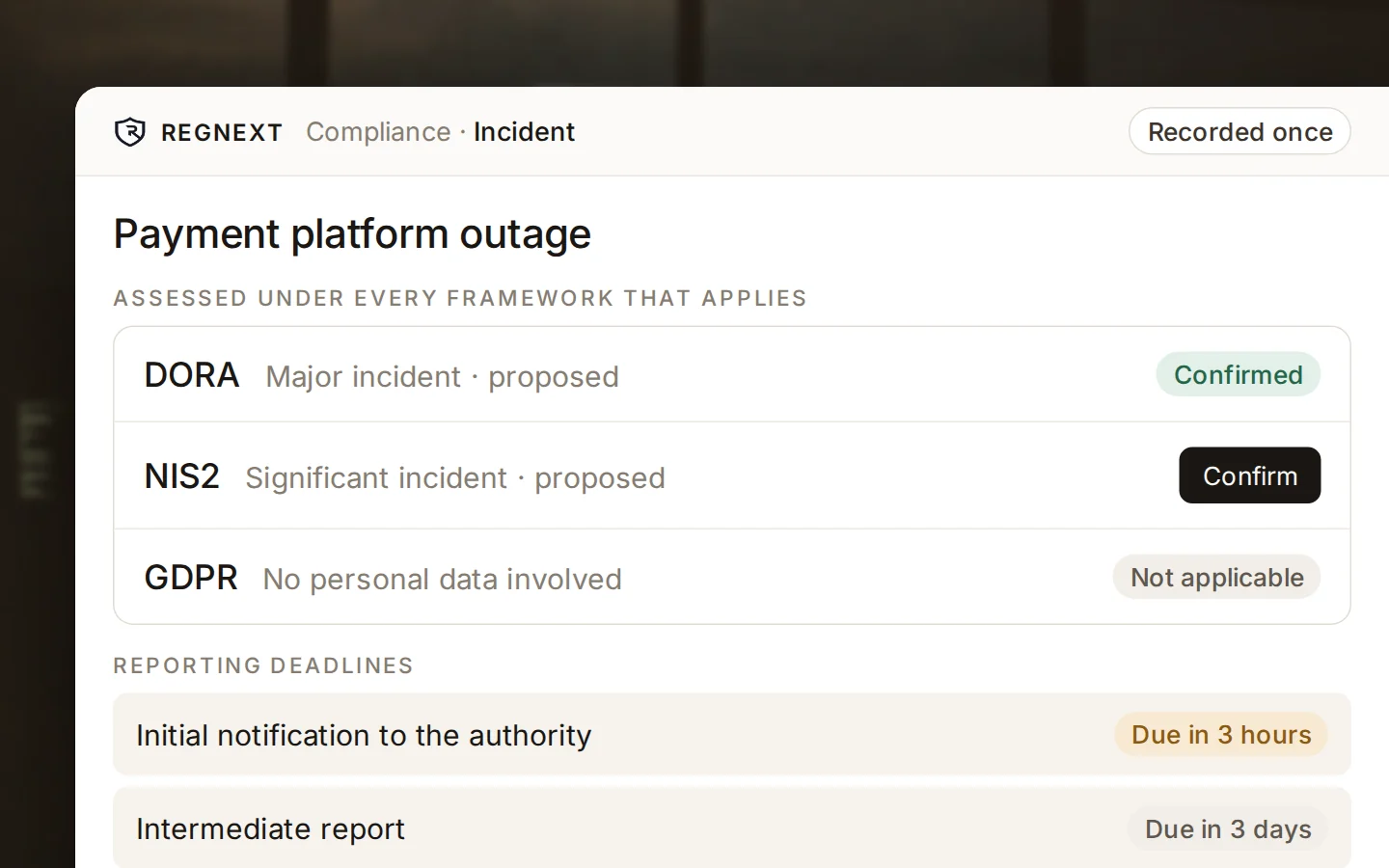
Record the facts once. RegNext proposes the classification under DORA, NIS2 and GDPR from the rules themselves, a person confirms it, and the reporting deadlines follow.

Classified from the rulesEach criterion shown with its legal text.
DeadlinesDated from the moment that counts.
Owner and assigneesWith severity and status.
LinkedTo the suppliers, risks and tasks involved.
One incident assessed under DORA, NIS2 and GDPR, each classification proposed and confirmed, with the reporting deadlines

Third parties & registers

Suppliers, functions and assets — recorded once.

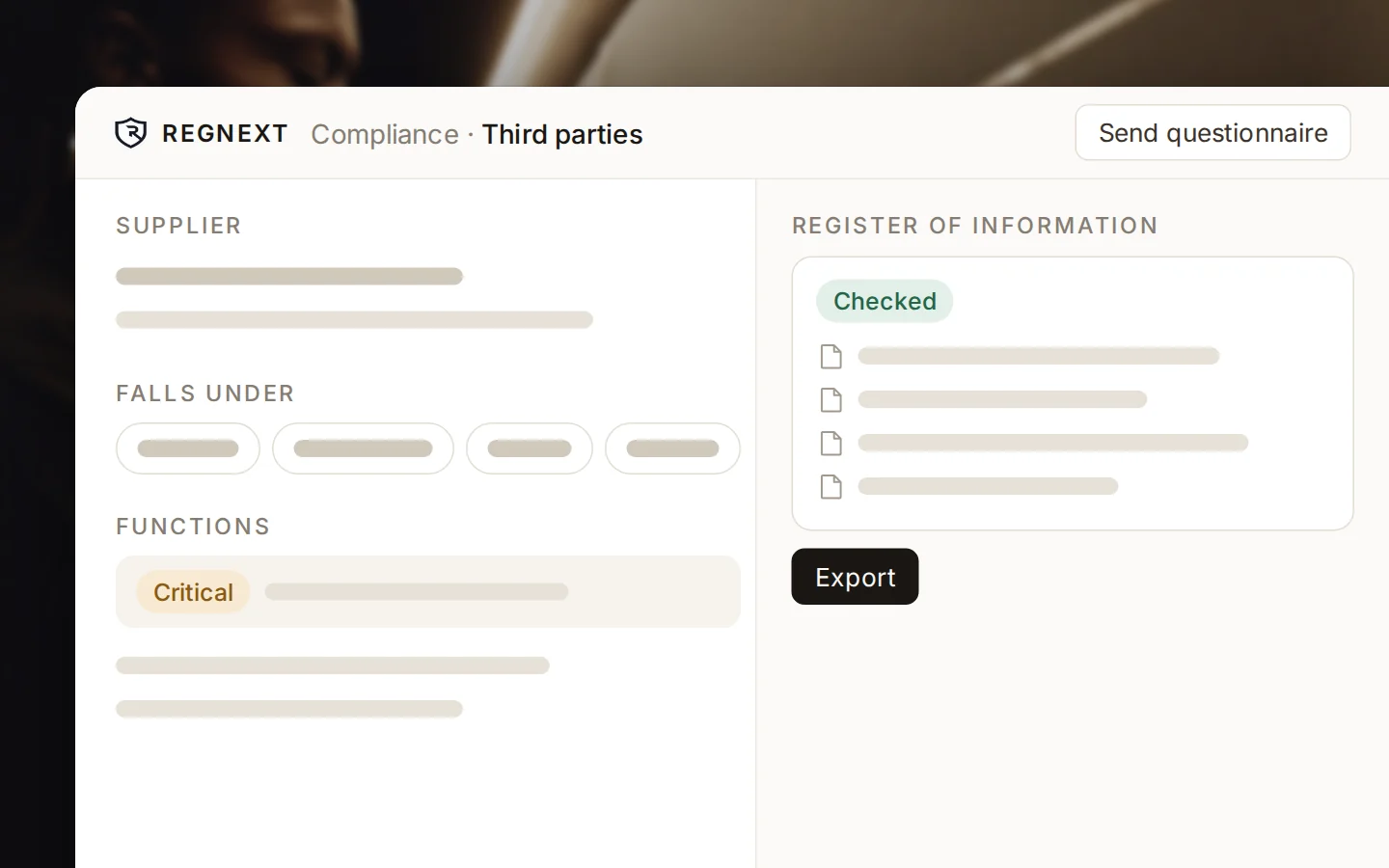
Record each supplier once and see which frameworks it falls under — ICT provider, outsourcing, processor, supply chain, AI provider. Map your functions, assets, processes and customers, assess which functions are critical, and export your DORA register of information.

Tagged per frameworkOne supplier, every regime that applies to it.
Critical functionsAssessed against the legal criteria.
Register of informationExported and checked before you file.
Supplier questionnairesGenerated for you to send.
A supplier record: the frameworks it falls under and the functions it supports, one marked critical, beside the register of information, marked checked, with an Export button

Audits

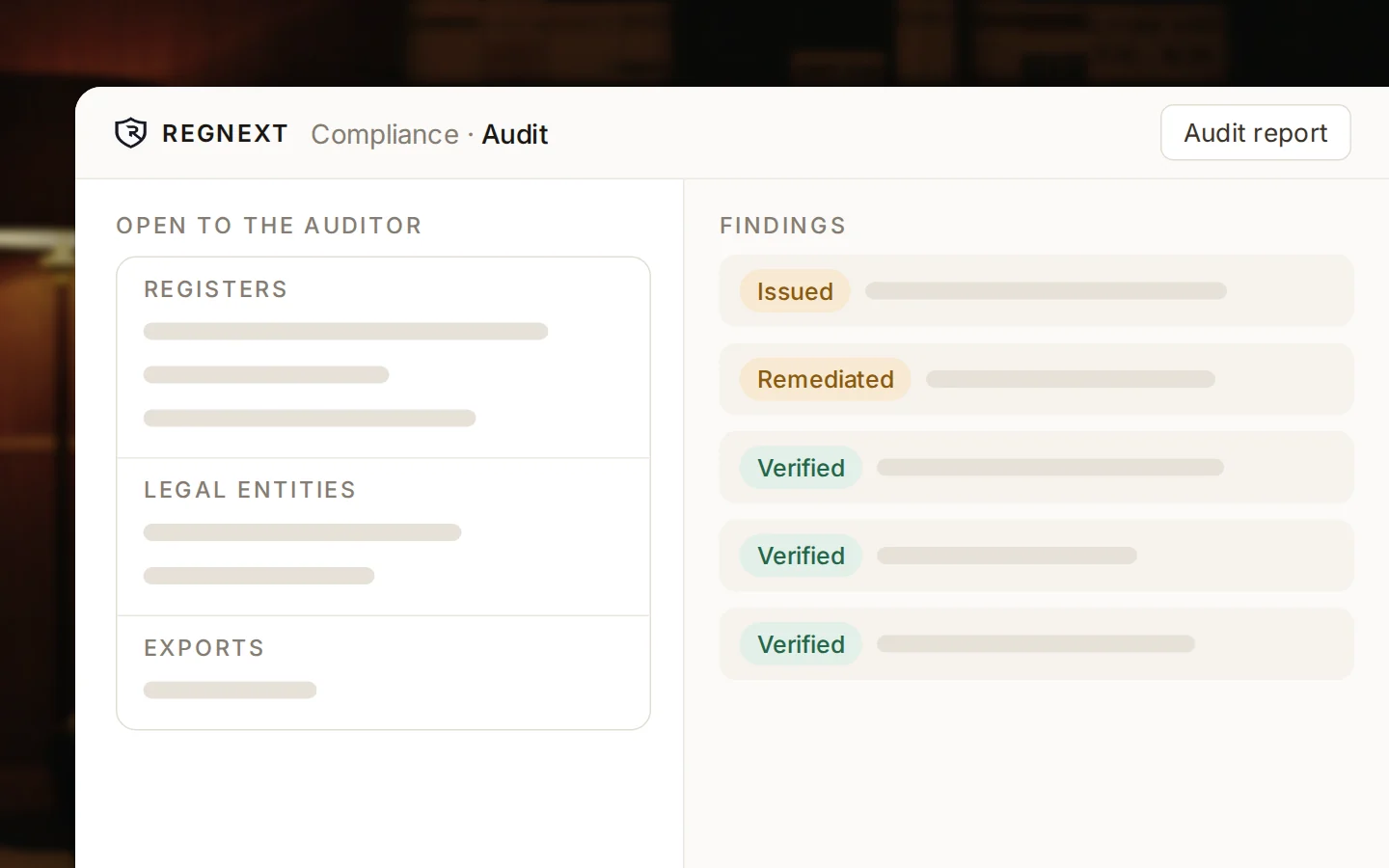
Your auditor works in the room you open.

Plan your audits and follow every finding to verified closure. An internal or external auditor gets a role of their own: they read what you open to them, and record their work where you follow it up.

Access you setNarrow it to some registers or some legal entities, with or without exports.
Findings to closureDrafted, issued, remediated — then verified by someone other than the owner.
A report per auditWork-programme steps, the conclusion and a PDF report.
Every visit recordedEach page an auditor opens is written to your security log.
What is open to the auditor (registers, legal entities, exports) beside a list of findings marked issued, remediated or verified, and an Audit report button

Certification

Preparing a certification? Keep the system running.

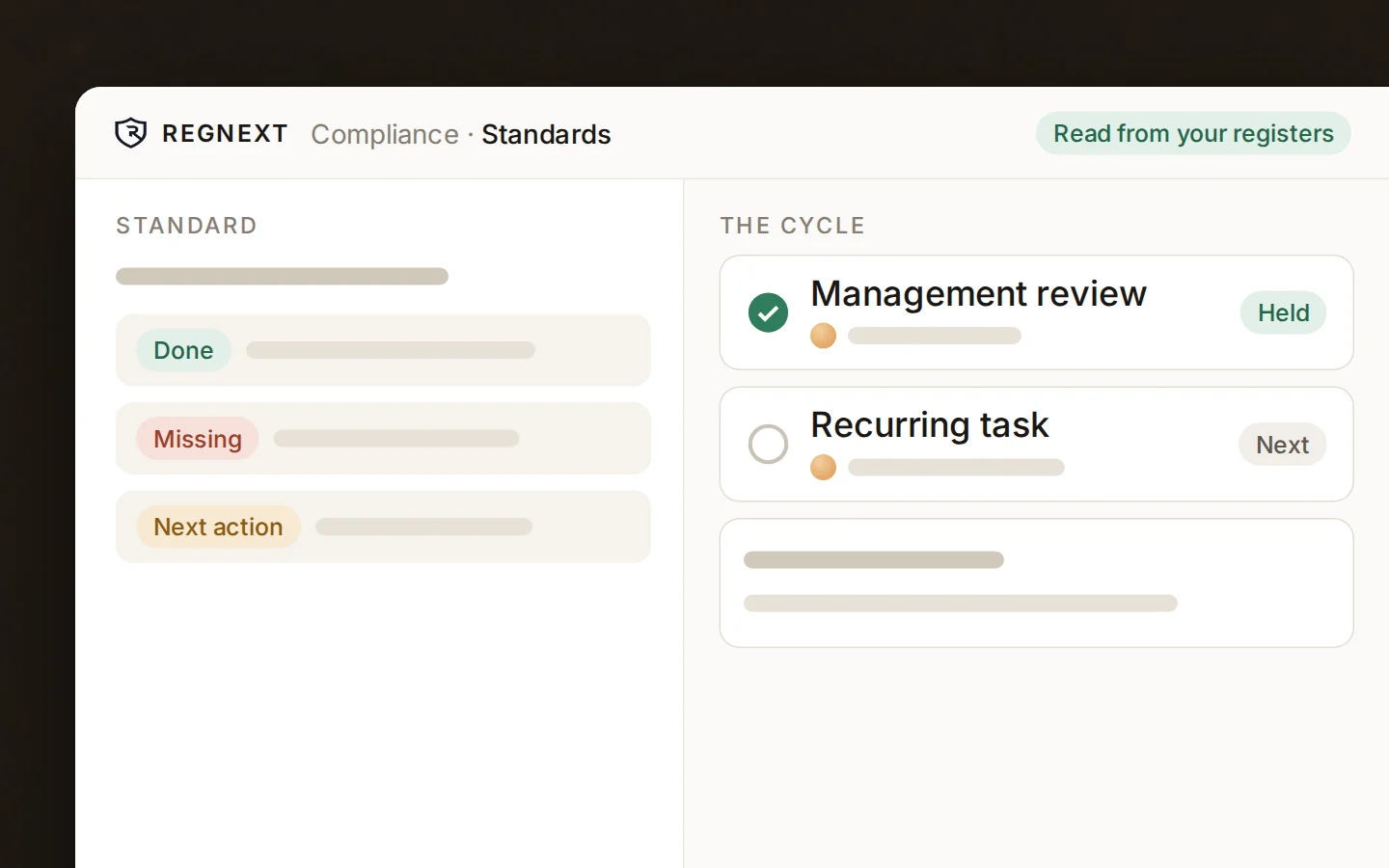
Follow the standards your firm works toward — ISO/IEC 27001, 42001 and 27701, ISO 22301, ISO 9001, and ISAE 3000 assurance reports: what is done, what is missing and the next action, read from your registers. A certificate is decided by an accredited certification body, an assurance report by an audit firm.

The cycle, in your calendarThe recurring tasks of the system, each with its frequency and its owner.
Management reviewsHeld, minuted and kept with their history.
A room for the auditorAccess scoped to one standard, with the evidence it calls for.
Statement of applicabilityYour decision on each requirement, with its controls — exported to Excel.
A standard followed from the firm's registers: what is done, what is missing and the next action, beside the cycle of recurring tasks, with a management review marked held

Also on record

Training

Management-body and staff training tracked person by person, against the duty each law sets.

Continuity

Impact analysis per function, continuity and recovery plans checked against what the rules say they must contain, and tests with recovery times against your objectives.

A pack for the board

A management-body pack per framework as a PDF, and a history of changes on every record.

Evidence from your directory

Snapshots from your staff directory — sign-in protection, account lifecycle, privileged accounts — attached to the controls they support, dated, and flagged when they go stale.

Sanctions screening

Names checked against the EU, UN, French and US lists by fixed matching rules. A reviewer decides, and the decision is kept with its evidence.

Compliance calendar

The recurring duties the law sets, each with its article, beside your own recurring tasks.

Compliance agent

One framework, worked gap by gap.

The agent reads your registers, asks what only your firm knows, and proposes each change for a person to approve. Nothing is written until someone approves it. Enabled for your firm on request.

Built in

The rules do the reading. Your team decides.

The law behind every requirement

Each requirement cites its article, and each criterion and test quotes the law.

Proposed, then confirmed

Classifications come from the rules themselves, and a person confirms them.

Your scope

The frameworks shown are the ones your firm has in scope.

Automations

Rules you switch on: when a supplier turns out to be critical or a major incident is confirmed, a task or a risk is created for its owner.

Everything linked

Risks, controls, policies, incidents and suppliers point to one another.

Personal data kept out

Data-subject requests are logged by reference, with no field for the person’s details.

How teams use it

One incident, several frameworks

A security lead records the facts once, confirms the classification proposed under each framework and sees the reporting deadlines.

A supplier, recorded once

A risk team records a supplier once, sees which frameworks it falls under and assesses which functions are critical.

An audit, to closure

An auditor reads what the firm opens, records the work there, and each finding is followed to verified closure.

Questions

Which frameworks does Compliance cover?

DORA, NIS2, the AI Act and GDPR are where most firms start. RegNext manages the other frameworks you answer to the same way, and a standard of your own runs beside them on the same controls. The frameworks shown are the ones your firm has in scope.

Does RegNext decide a classification for us?

No. RegNext proposes a classification from the rules themselves, with each criterion shown with its legal text. A person confirms it. The same holds for an incident and for an AI system.

Can we work with our own standard?

Yes. Import a standard you hold or an internal rulebook. Its requirements map to the same controls, so one control can serve both. A new version of a framework shows exactly what changed and never overwrites your own edits.

Does RegNext deliver a certification?

No. RegNext helps you prepare. For the standards your firm works toward, it shows what is done, what is missing and the next action, read from your registers. A certificate is decided by an accredited certification body, an assurance report by an audit firm.

image of brainstorming session for a productivity tools business

Transform compliance.
Accelerate outcomes.

Explore how RegNext supports regulatory intelligence and compliance execution in your industry.