Knowledge base

The law, broken down into what you must do.

RegNext breaks regulations down into obligations, requirements and actions, each tied to the article it comes from — with plain overviews, the texts around them, the dates that matter, and search by meaning across the texts.
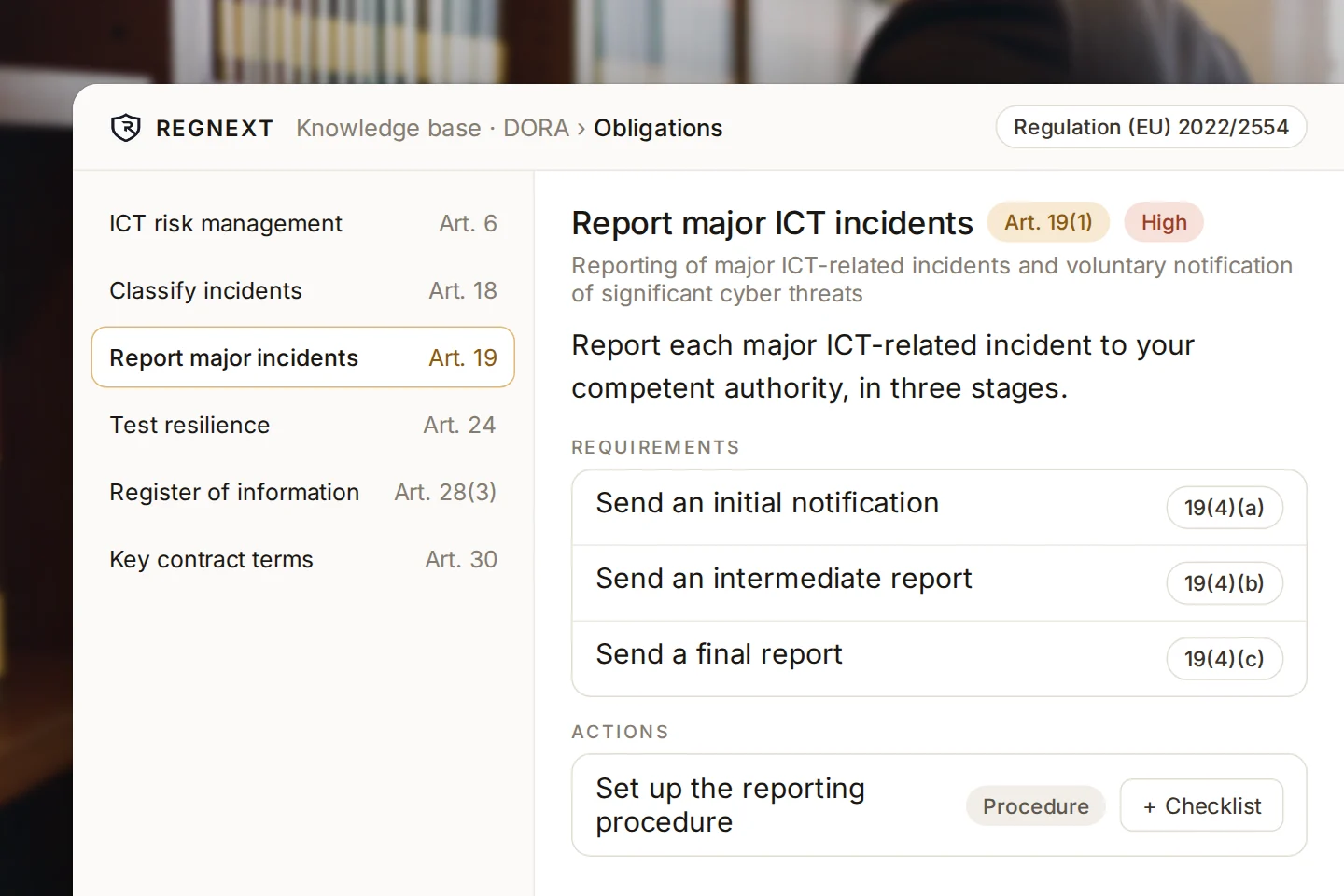
A regulation broken down into obligations, with the requirements and actions of the incident-reporting obligation and their article references
Broken downinto obligations, requirements and actions
Sourcedevery item tied to its legal basis
Connectedto implementing acts, guidance, case law and amendments
Searchableby meaning, across the texts

How it works

From the text of the law to what you must do.

Four steps between the official text and your team.

Read

The official texts, with their implementing acts, guidance and case law.

Break down

Obligations extracted from the text, then broken down into requirements and actions — and, for reporting frameworks, the rules to check.

Explain

A plain overview of the text: what it is, who it binds, when it bites and where readers go wrong.

Keep current

Amending acts and key dates, checked daily against the official publications.

One page per text

A regulation, explained on one page.

Start from the overview: what the text is, who it binds, when it bites and where readers usually go wrong. Then follow it out to the texts around it.
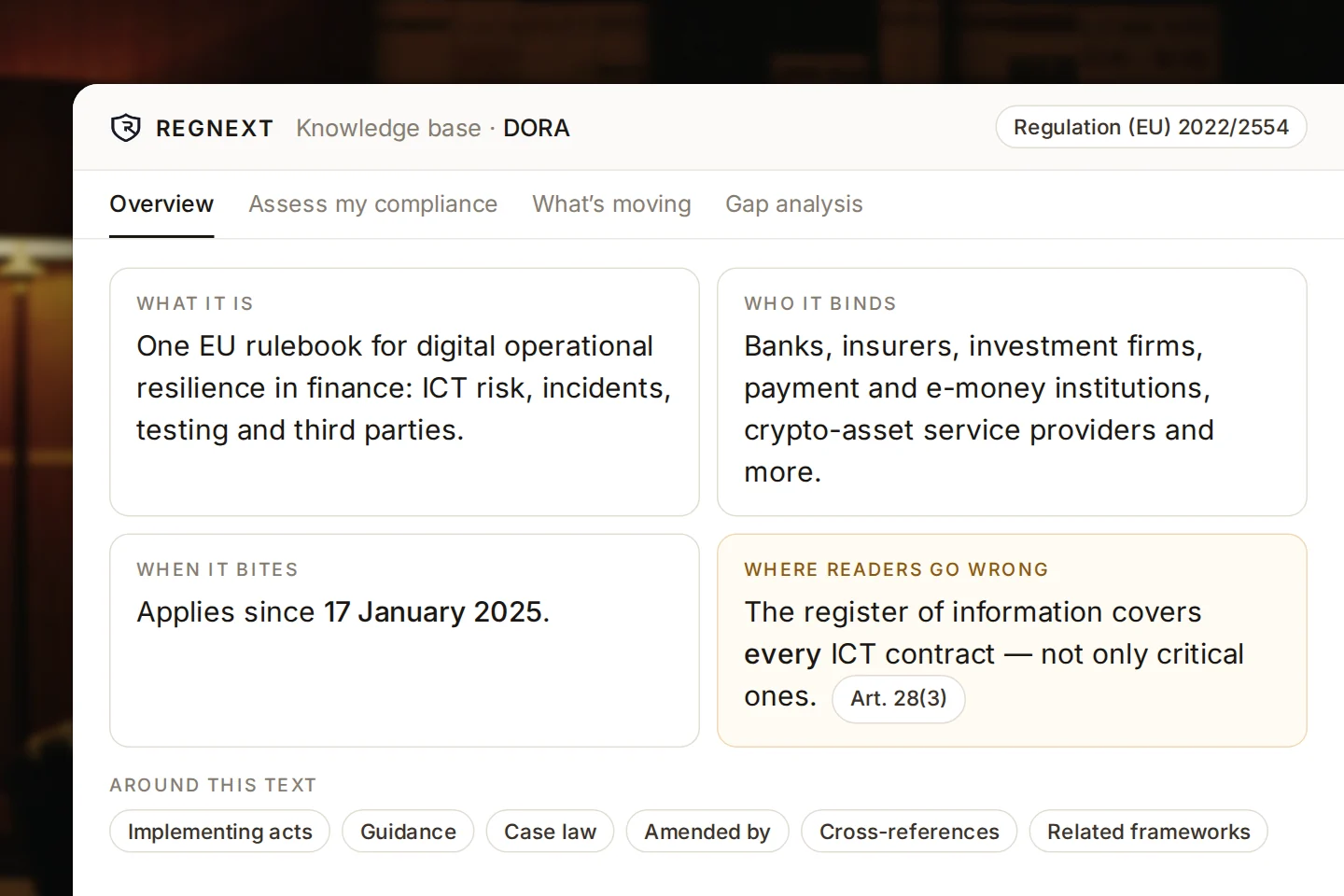
Implementing actsThe delegated and implementing acts that complete it.
Guidance and case lawWhat supervisors and the courts have said about it.
Amended byThe acts that have changed it.
Related frameworksCross-references and the rules that sit beside it.
The overview of a regulation: what it is, who it binds, when it bites, where readers go wrong, and the texts around it

Search

Ask in your own words.

Search the texts by meaning — no article number or exact wording needed. RegNext answers with what the text says and the articles it relies on, with the case law, guidance and definitions beside them.
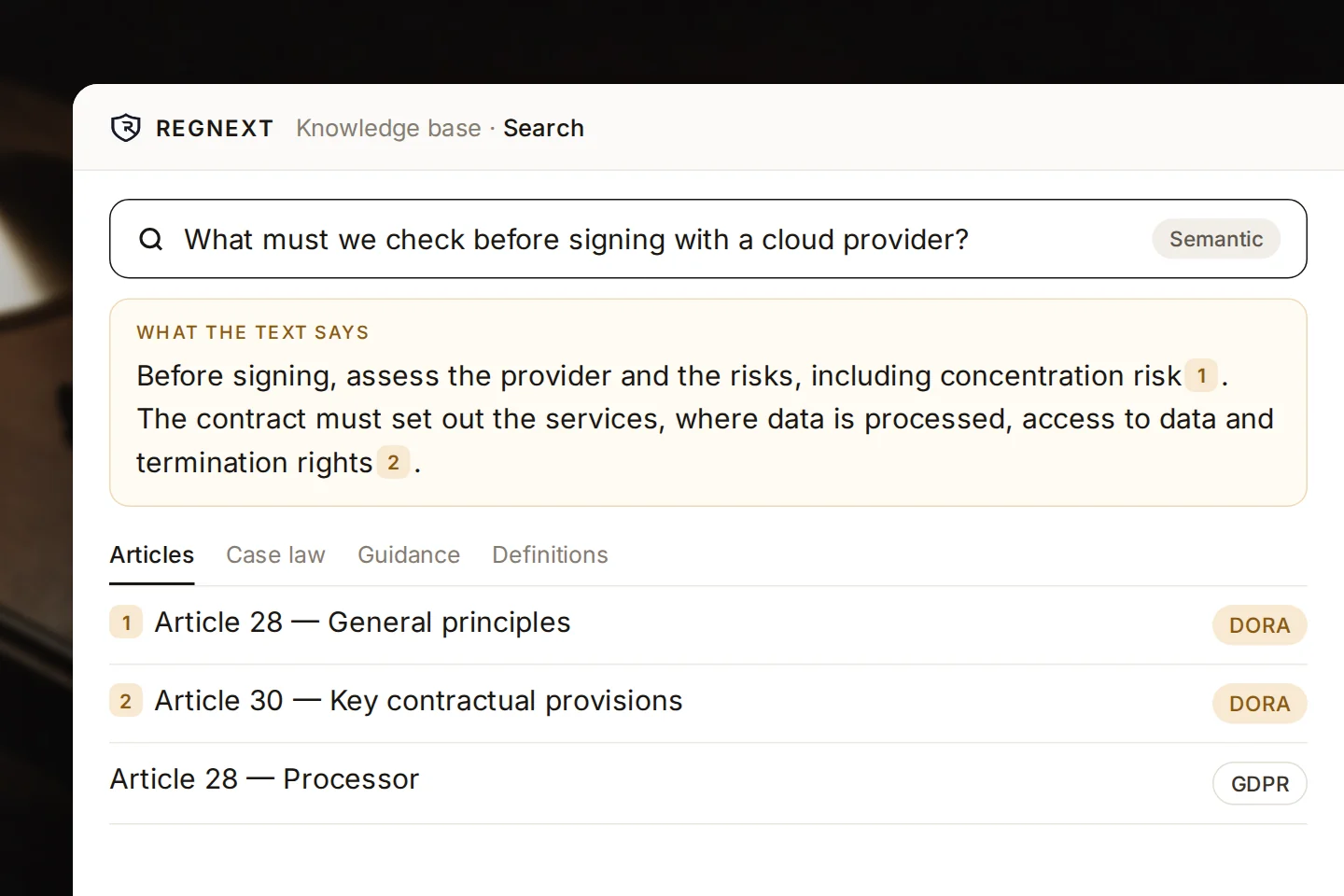
By meaning or by wordsSemantic, keyword, or both at once.
What the text saysA short answer, with the articles it relies on.
Beyond the articlesCourt judgments, supervisors’ guidance and definitions.
Narrow it downFilter the results by text.
A plain-language search answered with what the text says, citing two articles, and the matching articles listed below

What’s coming

See the law before it applies.

The amending acts already adopted, and when they will apply — checked daily against the official publications. Key dates line up in a calendar you can export.
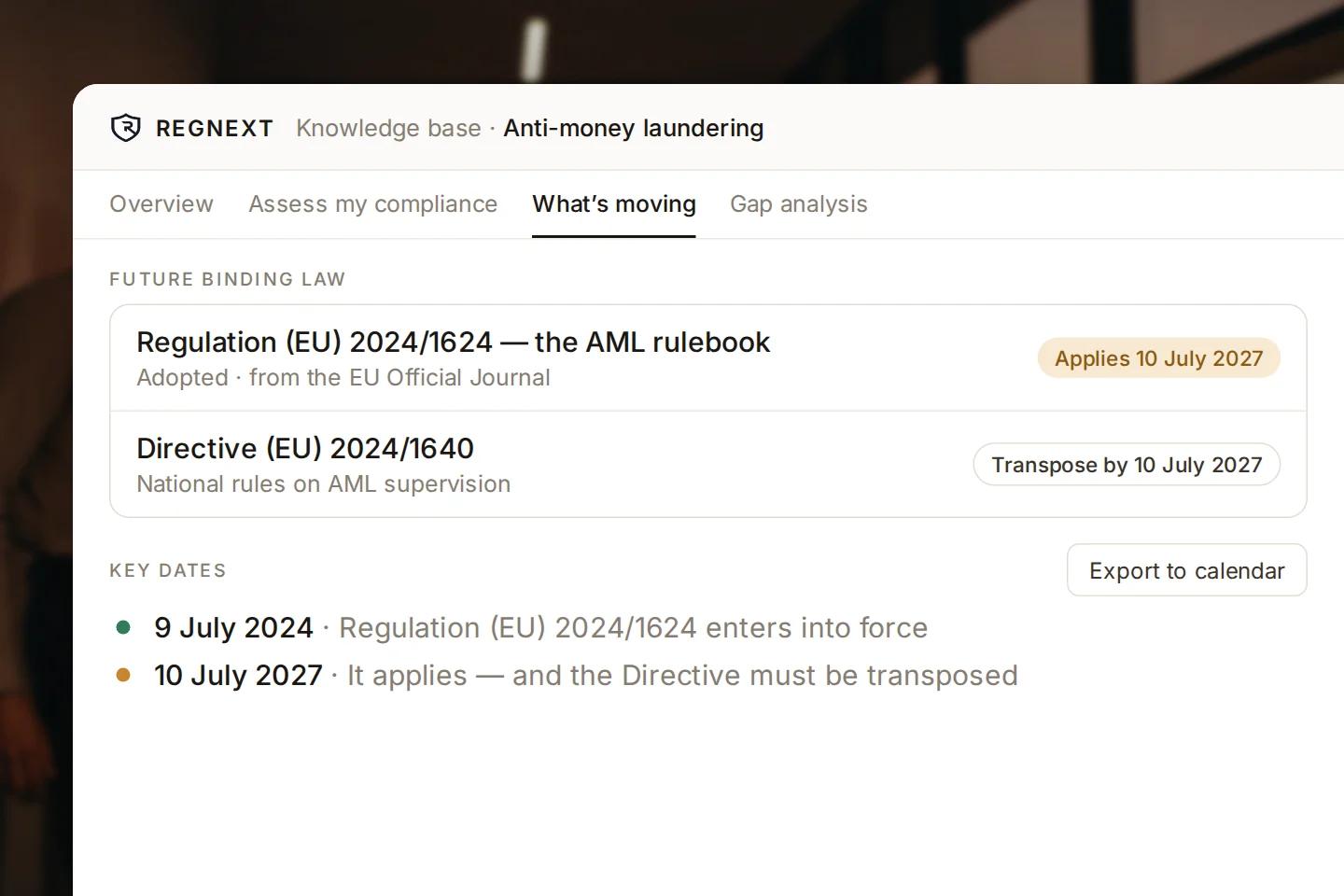
Future binding lawAdopted changes and the date they apply.
When it bitesEntry into force, application and transposition dates.
What’s movingDated events and news, pinned to the obligations they touch.
To your calendarExport the dates to your calendar or a spreadsheet.
Adopted amending acts with the dates they apply, and a regulation's key dates ready to export to a calendar

Coverage

The frameworks your teams work with.

Each one broken down into obligations and requirements, tied to its articles.

Banking

CRRCOREPFINREP

Insurance

Solvency IIIDDMotor insurance

Markets and crypto-assets

MiFID IIMiFIRMAREMIRCSDRMiCA

Digital and data

DORANIS2AI ActGDPR

Payments

PSD2E-moneySEPAInstant payments

Financial crime

AML RegulationAML DirectivesAMLATransfer of funds

Sustainability

CSRD

New frameworks and jurisdictions are added as our clients need them.

In your control

Built to be checked.

Tied to its legal basis

Every obligation shows the article it comes from; every requirement, its citations.

From the official texts

Texts, amending acts and implementing measures come from the official publications.

Rules to check

For reporting frameworks, the rules to check are listed under the requirements they belong to.

Where to start

Every action carries a type and a severity, so your team knows what comes first.

Into your checklist

Add an action to your team’s checklist straight from the obligation.

Misreadings flagged

Each overview points out where readers usually go wrong.

Questions

Questions about the knowledge base.

What is obligation extraction?

Reading a legal text and listing what it requires someone to do. In the RegNext knowledge base, a regulation is broken down into obligations, then into requirements and actions, and every item shows the article it comes from. For reporting frameworks, the rules to check are listed under their requirements.

What does the knowledge base cover?

The frameworks listed above, across banking, insurance, markets and crypto-assets, digital and data, payments, financial crime and sustainability — from DORA, NIS2, the AI Act and GDPR to MiCA and the AML rules. New frameworks and jurisdictions are added as our clients need them.

How can we check an obligation?

Every obligation shows the article it comes from, and every requirement its citations. Texts, amending acts and implementing measures come from the official publications, and each overview points out where readers usually go wrong.

How does it stay up to date?

Amending acts and key dates are checked daily against the official publications. Changes already adopted show the date they apply, and key dates can be exported to your calendar or a spreadsheet.

Do we need the article number to search?

No. Search the texts by meaning, by keywords or both. RegNext answers with what the text says and the articles it relies on, with court judgments, supervisors’ guidance and definitions beside them.

image of brainstorming session for a productivity tools business

Transform compliance.
Accelerate outcomes.

Explore how RegNext supports regulatory intelligence and compliance execution in your industry.